
Articles
A Fake Travels in Every Language. Verifieddit Now Speaks Five of Them.
A faked picture doesn't wait for a translation. From version 1.6.0, the Verifieddit extension for Chrome and the add-on for Firefox show who signed a picture, and whether it's labelled as AI, in English, German, Spanish, French and Italian. Verifying is still free, and your file still isn't uploaded.
Matthew Stevens|Director at SanMarcSoft LLC|
On 22 May 2023, a picture that claimed to show an explosion at the Pentagon went round Twitter faster than anyone could check it. The fire department in Arlington said there was no explosion and no incident. Wall Street dipped anyway, briefly, and then recovered. The picture had probably been made by an AI.
Nobody needed to read English to be fooled by it.
Two months earlier it was Pope Francis in a white puffer coat, an image out of an AI generator that plenty of people took for a photograph. That one was harmless. In March 2024 it ran the other way: the palace released a Mother's Day photo of the Princess of Wales with her children, and news agencies withdrew it that same evening because it looked manipulated. The next day she apologised and said that, like many amateur photographers, she sometimes experiments with editing. A real family in a real photo, and the agencies still couldn't stand behind it.
I keep coming back to these three because the question was the same each time, and it isn't a technical one. People wanted to know who made the picture and whether it was made with AI. A picture that carries Content Credentials can say so itself, and Verifieddit is the browser extension I built to read them: it shows who signed a picture and whether the signer labelled it as AI.
Until now it said all of that in English.
That bothered me. A fake doesn't wait for a translation, and somebody looking at one in Graz, Seville, Lyon, Bari or Buenos Aires shouldn't have to wait for one either.
What changes with 1.6.0
From version 1.6.0, the Verifieddit extension for Chrome and the add-on for Firefox speak English, German, Spanish, French and Italian. They follow the languages your browser asks for, so there's nothing to set up: the popup, the panel that opens on the page, the text you get when you hover over a badge, the right-click menu and the options page all come up in your language. Any other language gets English. The store name and description come in the five languages too.
If your browser is set to one language and you'd rather read in another, there's a language picker in the popup's Options tab and on the Firefox options page. It changes everything at once, without a reload, and it remembers what you chose. "Follow the browser" clears the choice.
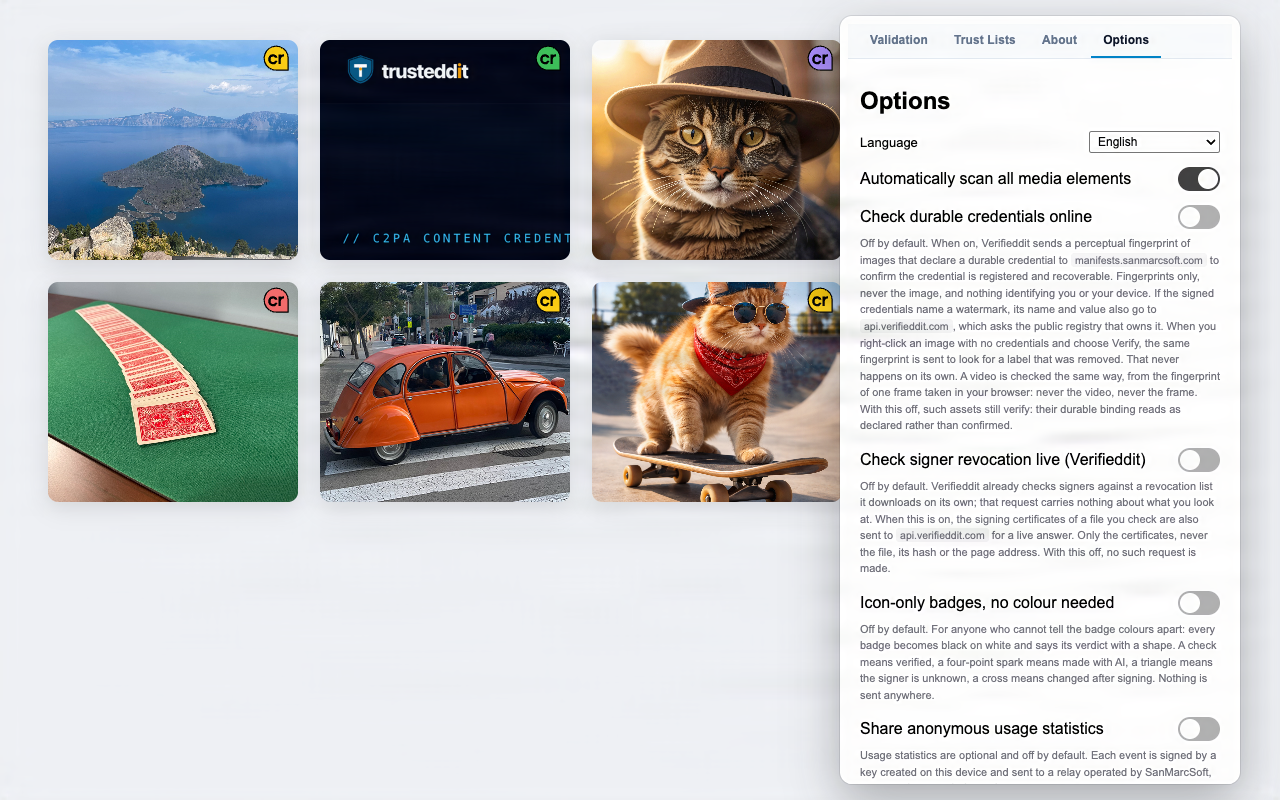
I left one thing in English on purpose: the technical C2PA status codes. A code ought to be the same string for everyone who looks it up.
The website got there first. verifieddit.com already speaks the same five languages, chosen from your browser's language, with a picker on every page.
What doesn't change
Verifying is free. It works in your browser, the file isn't uploaded, and the code is open source.
Version 1.6.0 is in both stores now. Install Verifieddit from the Chrome Web Store or from Firefox Add-ons, and the next time a picture stops you, ask it who made it.