
Articles
The Verifieddit Chrome Extension Is Here: Your Readers Can Now Check Who Signed Your Photos
Verifieddit is live on the Chrome Web Store and Firefox Add-ons, free and open source. It shows readers who signed the images, video and audio on any page. If you publish media, your audience can now check your work. This is what they will see, and how to make sure it is green.
Matthew Stevens|Director at SanMarcSoft LLC|
Updated 7 October 2026 for version 1.4, out for Firefox and in review at the Chrome Web Store, which serves the earlier badges until then. Since 11 November 2026 both stores carry version 1.6.0.
"The ideal subject of totalitarian rule is not the convinced Nazi or the convinced Communist, but people for whom the distinction between fact and fiction (i.e., the reality of experience) and the distinction between true and false (i.e., the standards of thought) no longer exist."
Hannah Arendt, The Origins of Totalitarianism (1951)1
Arendt was describing a project that took a state, a party and a secret police to pull off. Today it takes a text prompt.
If you run a picture desk, or a wire service, or you're the person at a publisher who has to answer for what goes out under the EU AI Act, you don't need me to tell you the flood is here. You've been standing in it for two years. What's changed, as of today, is that your readers can finally do something about it.
The Verifieddit extension is live on the Chrome Web Store and on Firefox Add-ons. It's free, the source is on GitHub under the MIT license, and it does one thing: it reads the cryptographic provenance inside the images, video and audio on whatever page you're on and tells you who signed them. That's it. I'll come back to why "that's it" is the whole point. If you publish, it means every person who installs this is now checking your work, on your site, on the platforms that carry your feed, and on your competitors' sites, and they're going to see one of four things.
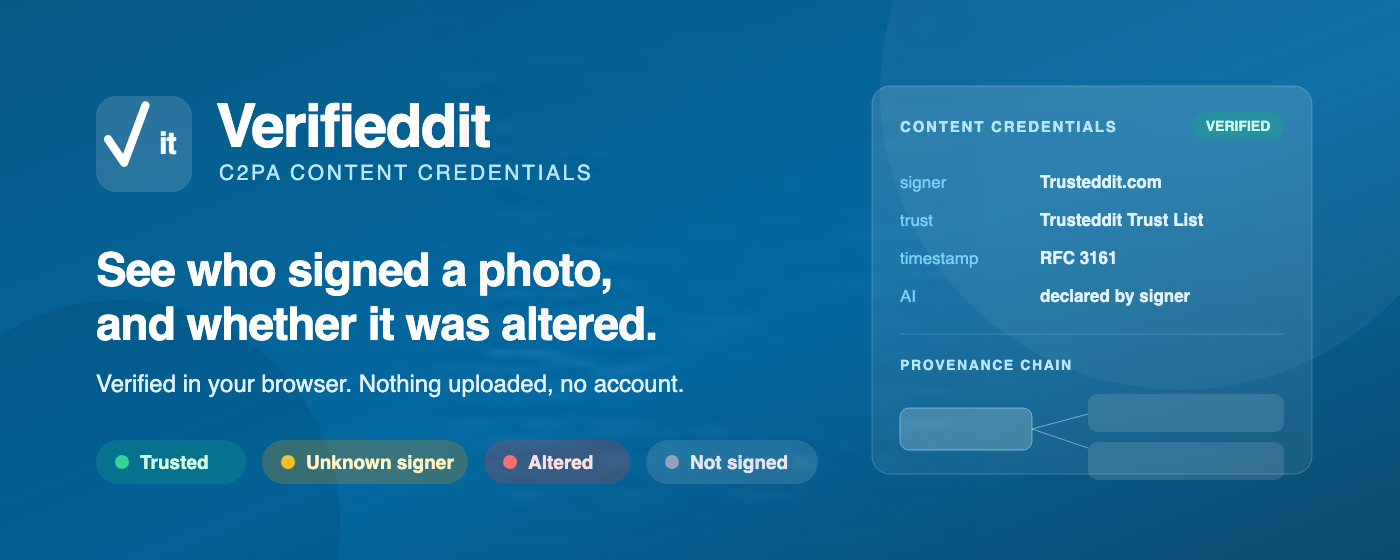
What the badge is reading
"Provenance" has turned into a marketing word, so let's be clear about what's under it. C2PA is an open specification2 for signing a media file at the moment it's captured or created. Adobe, Google, Microsoft, the BBC, Leica, Nikon and Sony all sit on the coalition and ship it in products you already own. A signed file carries a manifest, and it answers what a picture editor has always asked: who signed this, and which trust list vouches for that certificate; what's touched it since; when, backed by an RFC 3161 timestamp from an authority the signer doesn't control; whether a machine made it, which the signer declares in the IPTC digital source type field3; and whether the pixels are still the ones that got signed, because there's a hash, and it either matches or it doesn't.
None of that is new.
You could read all of it two years ago if you saved the file and dragged it into a checking tool. Almost nobody did, and honestly I don't blame them. Verifieddit puts a small badge in the corner of the picture while you scroll and does the reading for you.
Four verdicts, from where you're sitting
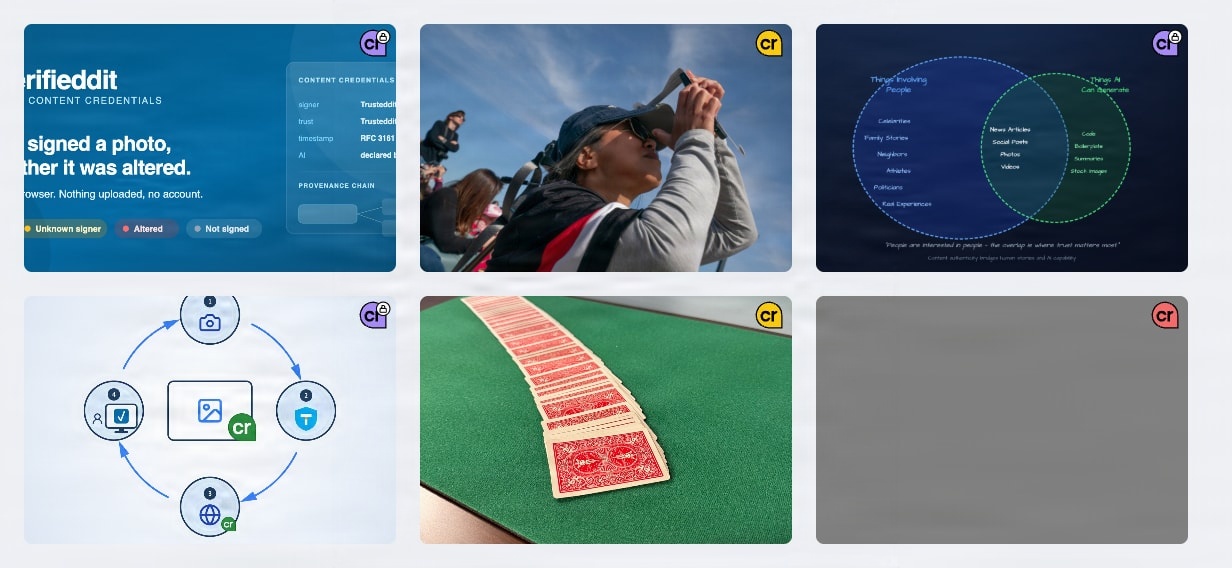
 Green means the file is signed, the signature is intact, and the signer chains to a trust list the reader accepts. That's your photo with your name on it, untouched since it left the desk.
 Purple is green for a file the signer declared as made with AI.
 Yellow means the manifest is valid but the signer isn't on any list the reader trusts yet. The maths checks out; nobody's vouched for you. Most early signers sit here, it's the one state you can fix yourself, and I'll get to how.
 Red means somebody altered the file after it was signed and the hash no longer matches, so when a crop changes what your photo says, that shows now. And no badge means no credentials at all, which is still most of the web (and, let's be honest, most of your competitors).
A lock in the badge's corner means a public registry holds a copy of the credential; an arrow means a stripped one was found again. An icon-only option draws each verdict as a black shape on white, for anyone who can't tell the colours apart.
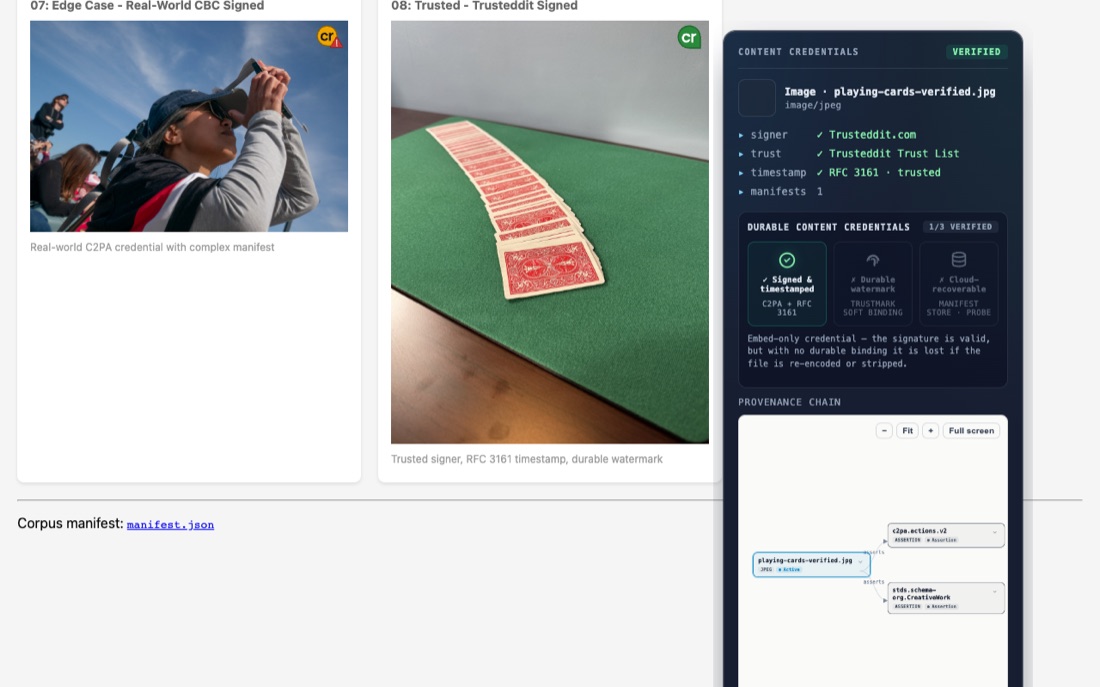
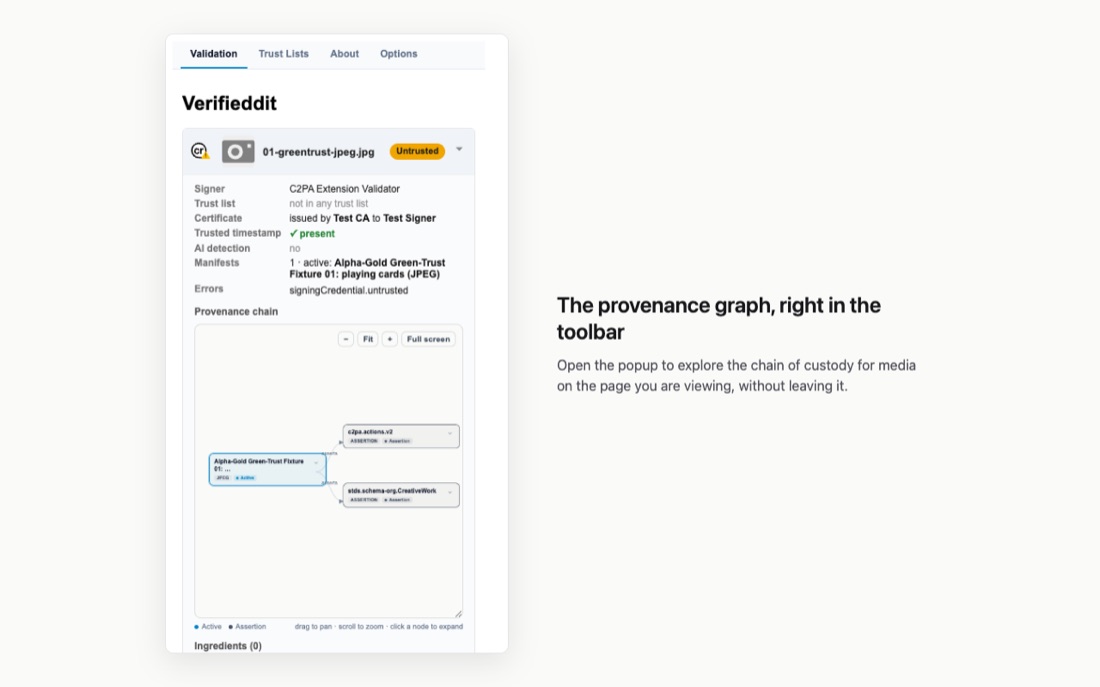
Click the badge and you get the whole chain of custody as a graph, with the signer's certificate, the timestamp authority and every ingredient a composite was built from.
What it won't do
It won't guess whether a picture is AI. Every "AI detector" you've been pitched does exactly that, and every one of them is wrong often enough to be dangerous in a newsroom, because one false positive on a staff photographer's frame and you're printing a correction. When Verifieddit says a file is AI-generated, it's reading a declaration the signer put in the manifest. A file with no declaration shows as "not declared", never as "not AI", because we don't know that, and pretending we did would be the same sin this whole project exists to fight.
It doesn't phone home either. Verification runs in your browser and nowhere else, there's no account, and nothing in the code tracks you. The source is a click away, and your legal team can read it before your readers do.
Whose trust list
This is the question that decides whether provenance is infrastructure or just another gatekeeper, and I've got a firm view on it.
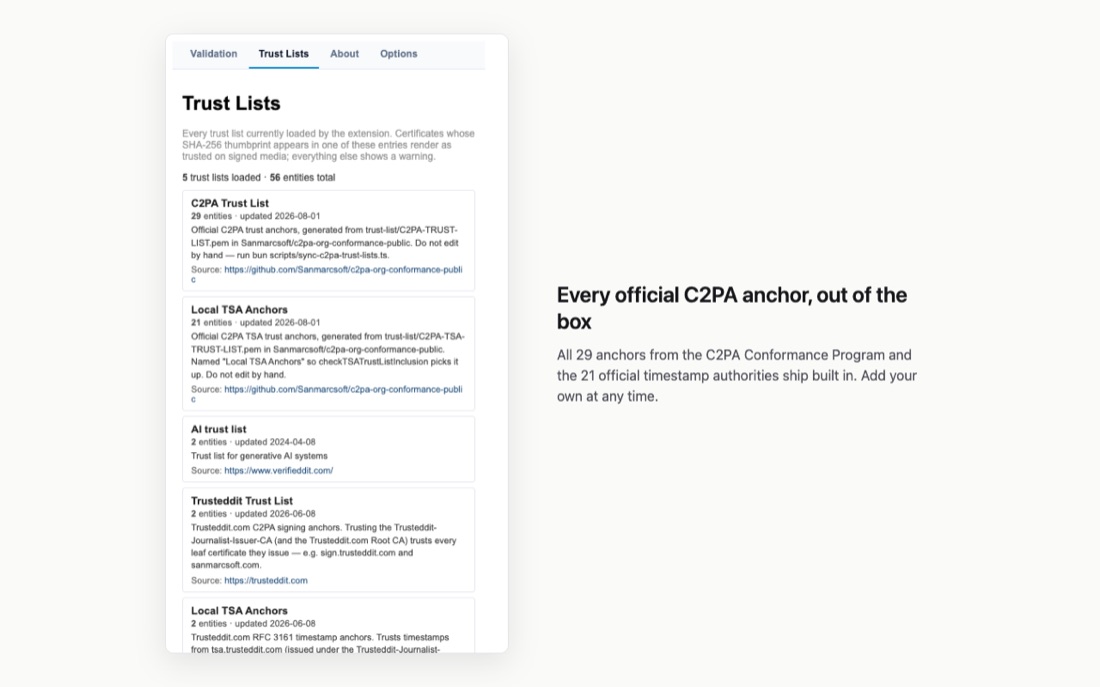
The extension ships with the anchors from the C2PA Conformance Program and the official C2PA timestamp authorities. Past that, the list belongs to whoever runs the browser. A newsroom can pin its own signing certificate so the picture desk trusts its own photographers and nobody else. An organisation can push the extension to every desk by policy with its own list already loaded, which Trusteddit sets up. Who you trust gets decided by you, from a list you control, and any other arrangement would just rebuild the platform problem with extra steps.
The four things editors ask me
The first is whether adoption is wide enough to matter yet. From 2 August 2026, Article 50 of the EU AI Act6 requires anyone deploying generative systems in the Union to label synthetic output in a machine-readable way, and C2PA is that label. The CBC photo in the screenshot above isn't a demo, it's a national broadcaster signing its output right now. Signing sets you apart this year. Next year it'll just be expected.
The second is how hard the integration is, and the honest answer is: not very. Signing at the producer edge is a single POST to a signing API. Your storage, your DAM and your editorial workflow stay exactly where they are. Trusteddit issues the producer certificate, puts an RFC 3161 timestamp on every signature, and has newsrooms signing in weeks rather than months.
The third is cost at volume. Pricing is in volume bands rather than per-asset retail, and if you're wire-scale we size it on a call, because a regional daily and an agency aren't the same feed.
The fourth is whether you can pilot it first. Yes, on a slice of your output, with a 30-day evaluation. Trusteddit handles the trust list enrollment, so the yellow badge on your pilot photos turns green when the pilot does. And if Article 50 is what brought you here rather than a picture desk, the same engagement comes with the audit pack, the data processing agreement and the service level agreement your compliance people will ask for.
Why I built it
I've argued before that every advance in AI's ability to generate content makes human judgment more valuable, not less. But judgment needs evidence, and the browser has been starving it. Habermas's public sphere4 only works if the people arguing in it can agree on what happened (not on what it means, just on what happened), and take away the ability to check and you get the scenario Levitsky and Ziblatt5 describe, where the gatekeeping institutions fail not because anyone attacked them but because nobody could tell any more what they were gatekeeping.
To those who say provenance is a niche concern for forensics labs, I'd suggest they've misread the moment. Arendt's warning wasn't about liars. It was about what happens to a public that stops believing the distinction is worth making.
So if you read the web, add Verifieddit to Chrome or Firefox and go look at who signed what. If you publish it, book twenty minutes with the Trusteddit team at SanMarcSoft and we'll size a pilot for your desk. Arendt's ideal subject was someone who'd stopped checking. Your readers just started.
- Hannah Arendt, The Origins of Totalitarianism (Schocken, 1951), part three, chapter thirteen.
- Coalition for Content Provenance and Authenticity, C2PA Technical Specification.
- IPTC, Digital Source Type NewsCodes.
- Jürgen Habermas, The Structural Transformation of the Public Sphere (1962).
- Steven Levitsky and Daniel Ziblatt, How Democracies Die (2018).
- Regulation (EU) 2024/1689, Article 50, transparency obligations, applicable from 2 August 2026.